How to Become Smarter
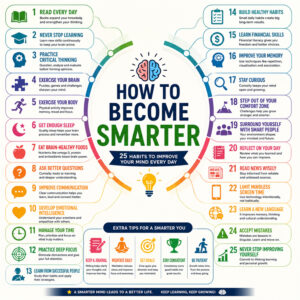
25 Proven Habits to Improve Your Mind Every Day
Discover 25 science-backed habits to become smarter every day. Learn how to improve memory, critical thinking, focus, communication, and lifelong learning with practical tips.
Have you ever wondered why some people seem to learn faster, solve problems more easily, and make better decisions? The answer isn’t always a higher IQ. In reality, becoming smarter is less about natural talent and more about developing habits that strengthen your brain over time.
The good news is that intelligence isn’t fixed. Your brain has an incredible ability to adapt and grow through a process called neuroplasticity. Every time you learn a new skill, challenge your thinking, or practice healthy habits, you’re creating stronger neural connections that improve your ability to think, remember, and make decisions.
Whether you’re a student, a working professional, an entrepreneur, or simply someone who wants to grow personally, becoming smarter can improve nearly every area of your life. It can help you perform better at work, build stronger relationships, manage money wisely, and solve everyday problems with greater confidence.
This guide shares practical, science-backed habits that anyone can start using today. You don’t need expensive courses or a genius-level IQ. Small, consistent actions can make a remarkable difference over time.
What Does It Really Mean to Be Smarter?
Many people think being smart means getting perfect grades or having an exceptionally high IQ. While intelligence tests measure certain cognitive abilities, they don’t define your overall potential.
Being smarter means improving several important skills, including:
- Critical thinking
- Problem-solving
- Creativity
- Emotional intelligence
- Communication
- Decision-making
- Learning efficiency
- Adaptability
A truly smart person isn’t someone who knows everything. Instead, they know how to keep learning, ask better questions, and apply knowledge effectively.
1. Read Every Day
Reading is one of the simplest and most effective ways to become smarter. Books expose you to new ideas, vocabulary, perspectives, and experiences that you might never encounter otherwise.
Try reading for at least 20–30 minutes every day. Mix different types of content, including:
- Nonfiction
- Biographies
- Science
- Psychology
- Business
- History
- Personal development
Reading regularly improves concentration, memory, comprehension, and analytical thinking.
2. Never Stop Learning
The world’s most successful people never stop being students.
Learn something new every month. This could include:
- A new language
- Coding
- Photography
- Public speaking
- Investing
- Cooking
- Graphic design
Learning new skills forces your brain to create new neural pathways, keeping it active and adaptable.
3. Practice Critical Thinking
Don’t accept everything you read or hear at face value.
Ask yourself:
- Is this information reliable?
- What evidence supports it?
- Could there be another explanation?
- What biases might exist?
Critical thinking helps you make informed decisions instead of reacting emotionally or relying on assumptions.
4. Exercise Your Brain
Your brain needs regular workouts just like your body.
Great brain exercises include:
- Crossword puzzles
- Sudoku
- Chess
- Logic puzzles
- Memory games
- Strategy games
These activities improve concentration, reasoning, and problem-solving abilities.
5. Exercise Your Body
Physical exercise benefits your brain as much as your muscles.
Regular activity:
- Increases blood flow to the brain
- Improves memory
- Reduces stress
- Enhances focus
- Supports long-term cognitive health
Aim for at least 150 minutes of moderate exercise each week. Walking, cycling, swimming, or strength training are all excellent choices.
6. Get Enough Quality Sleep
Many people sacrifice sleep to be more productive, but this often has the opposite effect.
During sleep, your brain:
- Consolidates memories
- Removes waste products
- Processes new information
- Restores mental energy
Adults should generally aim for 7–9 hours of quality sleep each night to support optimal cognitive performance.
7. Eat Foods That Support Brain Health
Your brain needs the right nutrients to function well.
Include foods such as:
- Fatty fish rich in omega-3s
- Blueberries
- Leafy green vegetables
- Eggs
- Nuts
- Seeds
- Whole grains
Also, stay hydrated throughout the day. Even mild dehydration can reduce concentration and mental performance.
8. Learn to Ask Better Questions
Smart people don’t always have the best answers—they often ask the best questions.
Instead of asking:
“Why does this always happen to me?”
Try asking:
“What can I learn from this experience?”
Curiosity drives learning. Asking thoughtful questions helps you discover new ideas, solve problems more effectively, and continue growing.
9. Improve Your Communication Skills
Being smart isn’t only about what you know—it’s also about how well you communicate your ideas. Strong communication helps you build relationships, solve problems, and succeed in both your personal and professional life.
To improve your communication skills:
- Listen more than you speak.
- Think before responding.
- Expand your vocabulary naturally through reading.
- Practice writing every day.
- Learn to explain complex ideas in simple words.
Great communicators are often perceived as more knowledgeable because they express their thoughts with clarity and confidence.
10. Develop Emotional Intelligence
Emotional intelligence (EQ) is just as important as IQ. It helps you understand your own emotions while recognizing and responding to the feelings of others.
People with high emotional intelligence tend to:
- Stay calm under pressure.
- Handle conflict effectively.
- Build stronger relationships.
- Make better decisions.
- Show empathy and respect.
Improving your emotional intelligence starts with becoming more self-aware and learning to manage your reactions.
11. Manage Your Time Wisely
Time is one of your most valuable resources. Smart people know how to prioritize important tasks instead of staying busy all day.
Helpful time management habits include:
- Planning your day the night before.
- Setting clear priorities.
- Breaking large goals into smaller tasks.
- Limiting distractions.
- Taking regular breaks to maintain focus.
Working smarter often produces better results than simply working longer hours.
12. Practice Deep Focus
Constant notifications and multitasking can reduce your ability to concentrate.
To improve focus:
- Turn off unnecessary notifications.
- Work in distraction-free environments.
- Focus on one task at a time.
- Use techniques like the Pomodoro Method.
- Schedule dedicated learning sessions.
Deep focus allows your brain to process information more effectively and improves the quality of your work.
13. Learn From Successful People
You don’t have to make every mistake yourself. Study the habits, strategies, and decisions of successful people.
Read biographies, watch educational interviews, and learn from experts in your field. Pay attention not only to their achievements but also to how they overcame failures.
Success leaves clues, and smart people learn from them.
14. Build Healthy Daily Habits
Your daily routine shapes your future.
Small habits repeated consistently can create significant improvements over time.
Examples include:
- Reading every morning.
- Exercising regularly.
- Writing down ideas.
- Reviewing your goals.
- Practicing gratitude.
- Learning one new thing every day.
Consistency beats perfection.
15. Learn Basic Financial Skills
Financial intelligence is an important part of becoming smarter.
Understand concepts such as:
- Budgeting
- Saving
- Investing
- Compound interest
- Credit scores
- Debt management
Making smart financial decisions reduces stress and creates more opportunities for your future.
16. Improve Your Memory
A strong memory helps you learn faster and retain information longer.
Simple ways to improve memory include:
- Repeating important information.
- Teaching what you’ve learned to someone else.
- Using visual associations.
- Writing notes by hand.
- Reviewing information regularly.
Memory improves with practice, just like any other skill.
17. Stay Curious
Curiosity is one of the biggest drivers of intelligence.
Ask questions such as:
- Why does this work?
- How can it be improved?
- What can I learn from this?
- Is there a better solution?
Curious people continue learning throughout their lives, which helps them stay mentally sharp.
18. Step Outside Your Comfort Zone
Growth rarely happens when everything feels comfortable.
Challenge yourself by:
- Learning unfamiliar skills.
- Speaking in public.
- Traveling to new places.
- Meeting different people.
- Taking on difficult projects.
Every challenge strengthens your confidence and expands your abilities.
19. Surround Yourself With Positive and Intelligent People
The people around you influence your mindset, habits, and decisions.
Choose friends and mentors who:
- Encourage growth.
- Value learning.
- Inspire positive habits.
- Challenge your thinking.
- Support your goals.
A positive environment makes personal growth much easier.
20. Reflect on Your Day
Spend a few minutes each evening asking yourself:
- What did I learn today?
- What went well?
- What mistakes did I make?
- How can I improve tomorrow?
Self-reflection helps you learn from experience instead of repeating the same mistakes.
21. Read News From Reliable Sources
Staying informed helps you understand the world and make better decisions. However, not all information online is accurate. Follow reputable news organizations and fact-check important stories before accepting them as true. Reading balanced, evidence-based news improves your critical thinking and broadens your perspective.
22. Limit Mindless Screen Time
Social media and endless scrolling can consume hours without adding much value. While technology is useful, using it without purpose can reduce focus and productivity.
Instead of spending hours scrolling, try to:
- Read an educational article.
- Watch a documentary.
- Take an online course.
- Listen to an informative podcast.
- Practice a new skill.
Replacing even 30 minutes of unproductive screen time each day can make a noticeable difference over a year.
23. Learn a New Language
Learning another language is one of the best exercises for your brain. It strengthens memory, improves concentration, enhances problem-solving skills, and helps you understand different cultures.
You don’t need to become fluent overnight. Practicing for just 15–20 minutes a day can lead to steady progress over time.
24. Accept Mistakes as Learning Opportunities
Everyone makes mistakes—even highly successful people. The difference is that smart people learn from them instead of giving up.
When something goes wrong, ask yourself:
- What happened?
- Why did it happen?
- What can I do differently next time?
Viewing mistakes as lessons rather than failures helps you grow faster and become more resilient.
25. Never Stop Improving Yourself
Perhaps the most important habit is committing to lifelong learning. Intelligence is not a destination; it is a continuous journey.
Read books, develop new skills, seek constructive feedback, and remain open to new ideas. Even small improvements made consistently can lead to significant personal and professional growth over time.
Final Thoughts
Becoming smarter doesn’t require extraordinary talent or a genius-level IQ. It comes from making intentional choices every day. Reading regularly, staying curious, exercising your body and mind, sleeping well, managing your time, improving your communication, and learning from both success and failure all contribute to a sharper, more capable mind.
Remember that progress takes time. You won’t become smarter overnight, but if you commit to these habits and practice them consistently, you’ll notice meaningful improvements in your thinking, confidence, productivity, and decision-making.
The smartest people aren’t those who know everything—they’re the ones who never stop learning.
Frequently Asked Questions (FAQ)
Can anyone become smarter?
Yes. Research shows that the brain can adapt and develop throughout life. By practicing healthy habits, learning continuously, and challenging yourself, you can improve many aspects of your cognitive abilities.
How long does it take to become smarter?
There is no fixed timeline. Many people notice improvements in focus, memory, and problem-solving within a few weeks of consistently practicing good habits, while lasting changes develop over months and years.
Does reading really make you smarter?
Yes. Reading expands your knowledge, improves vocabulary, strengthens comprehension, and enhances critical thinking. It also exposes you to new perspectives and ideas.
What’s the best daily habit for becoming smarter?
There isn’t just one. Combining regular reading, quality sleep, physical exercise, continuous learning, and critical thinking creates the greatest long-term benefits.
Can exercise improve brain function?
Absolutely. Regular physical activity increases blood flow to the brain, supports memory, improves mood, and contributes to better overall cognitive health.